When Netflix detects your automation script and blocks it, or when your UI test breaks because TikTok shifted a button overnight, you're seeing the core challenge of mobile app automation in action. Traditional methods simply weren't built for the complexity and pace of modern Android apps.
OCR-based text recognition, screenshots, or brittle UI scripts often collapse under real-world conditions. They're fragile, demand constant upkeep, and rarely adapt to the dynamic nature of apps today.
That's why LLM-powered Android agents matter. By combining the reasoning power of large language models with the scalability of AWS cloud services, teams can automate Android interactions in a way that's not just faster, but context-aware and far more reliable.
Armakuni helps organisations adopt these modern engineering practices and get real business value. To make it real, we've built a live demo that shows exactly how this works in practice.
#The challenge of Android automation
Automating Android apps is not the same as browser-based automation. Web pages follow standards and predictable structures; Android apps don't. Each device, OS version, or app update can change how the interface looks and behaves.
Then there are security restrictions. Apps like TikTok and Netflix actively block scraping or automation attempts to protect content. Combined with Android's sandboxing rules, even simple tasks become complicated.
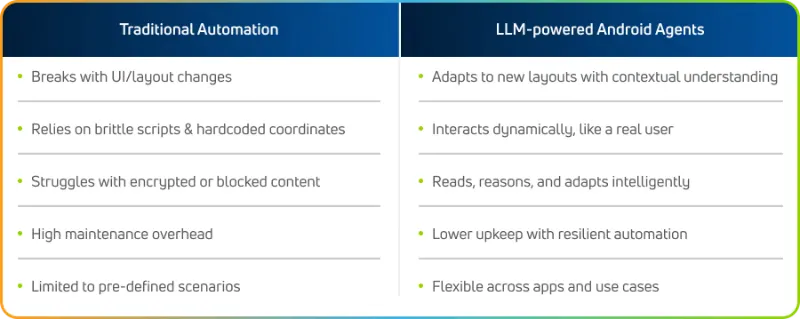
Traditional workarounds offer temporary relief but quickly turn into maintenance nightmares. They break with layout changes, misread text, or fall behind encrypted content.
This leaves teams fixing scripts instead of solving problems.
To move forward, we need an approach that can adapt and understand context. That's why LLM-powered Android agents matter.
Here's how traditional methods compare to LLM-powered Android agents:
#Building LLM-powered Android agents on AWS
To build LLM-powered Android agents, we start by running an Android VM on a Linux EC2 instance. This gives us a stable, cloud-hosted device to work with.
The next step is training Amazon Nova Pro to speak the language of Android, the Android Debug Bridge (ADB). With ADB, the LLM can send commands, check logs, and control the device.
For perception, we don't rely on expensive vision APIs. Instead, we use the Accessibility API to capture the screen state as XML. This structured data shows the LLM the available buttons, text, and layouts. Along with base64-encoded screenshots, the model gains enough context to "see" and reason about the screen.
Once it understands the state, the agent can act, like tapping buttons, opening apps, or installing software, just like a user would.
AWS makes this possible. With EC2, you can run multiple Android agents in parallel, giving teams reliable, cloud-native automation without fragile scripts.
#Demo in action: Instagram use case
Imagine an Android agent scrolling through Instagram in the cloud.
It captures screenshots and reads the post details: the account name, the caption, even the follower count. With that context, it makes a decision.
Next, the agent taps the "Follow" button. No breakable scripts, no guessing coordinates. A genuine interaction, as if a real user were holding the phone.
That's the breakthrough. For the first time, automation isn't just replaying clicks. It's reasoning about what's on the screen and taking thoughtful action.
And this doesn't stop at Instagram. The same approach extends to apps like TikTok, Netflix, or any other Android app where traditional automation fails.
Watch the full demo.
#Real-world applications & what's next
LLM-powered Android agents open up a new class of automation. From social media platforms where scraping is restricted, to enterprise workflows that run entirely on mobile apps, the possibilities are endless. These agents can test, interact, and execute tasks at scale, without relying on brittle simulations.
Looking ahead, combining this with cloud-native pipelines will make automation even more intelligent and resilient. That's where AWS brings its strength, scalability, reliability, and the ability to run many agents simultaneously.
At Armakuni, we use our PUSH framework to ensure these AI projects don't just remain proofs of concept but deliver real, long-term value. You can learn more here.
Watch the full demo on YouTube, and if you're exploring how LLMs and AWS can power your next mobile automation use case, let's talk.