More than 80% of AI projects fail, according to a recent report from RAND. That's double the failure rate of traditional IT projects. Despite investing billions into AI, many projects cannot withstand real-world pressures. Nor companies can get the outcomes they expected. One main reason for this is skipping the important step of determining whether a project is worth pursuing.
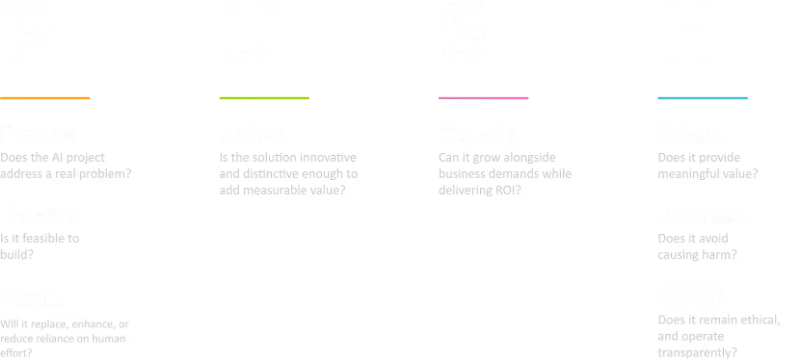
Does the solution solve a genuine problem? Will it reduce costs, improve productivity, or enhance ROI? Is it scalable, ethical, and innovative? These questions demand attention early on.
As an AWS Premier Partner and Generative AI Competency holder, with experience across 7+ industries, we've seen how focusing on realistic outcomes from the start can determine a project's success. So, to help businesses avoid AI blunders and make smarter investments, we created the PUSH framework.
#What is the PUSH Framework?
Most AI projects are expensive, time-consuming, and prone to errors like poor data quality, integration failures, and biases. These challenges make it hard for businesses to align AI initiatives with strategic goals. The result is: missed deadlines, wasted resources, and failed ROI.
The PUSH Framework helps businesses address these gaps, ensuring projects are feasible, aligned with objectives, and ethically sound, with a focus on practicality, scalability, and high success rates from POC to production.
Skipping this evaluation can lead to high-profile failures, like IBM's Watson for Oncology. This $4 billion venture aimed to revolutionise cancer treatment but failed due to limited training data and inaccurate recommendations. Without broader applicability, the project was scaled back.
P: Problem, Possible, People
AI projects often fail because they chase trends instead of solving real problems. The first step is to ask: Does this project tackle an issue that truly matters to the business or its customers? For example, what's the point of building an AI chatbot when it can't reduce customer wait time?
Then comes whether it's possible to build the solution. Do you have the right data, tools, resources, and infrastructure to make it work? What's the use of designing a predictive model if you don't have the data to train it properly?
Finally, AI doesn't work in isolation. It needs to fit with how people work, whether it's helping them do their jobs better, automating repetitive tasks, or creating entirely new opportunities. Projects that ignore these dynamics often encounter pushback, poor adoption, or ethical challenges.
Understanding the intricate interplay between these three factors: problem, possible, and people separates successful AI initiatives from those that fail.
Take the example of a major retailer that wanted to use AI to predict customer preferences. While the idea sounded good, they didn't evaluate whether their data systems were robust enough to process the massive volume of store data or whether the insights generated would actually be useful. Without addressing these key aspects of feasibility and relevance, the system ended up being slow and inaccurate, resulting in wasted time and money.
In contrast, a leading data-driven marketing agency we worked with had a clear problem: they were manually analysing over 40,000 calls daily, which was slow and often unreliable. By focusing on the core issue of speed and accuracy and ensuring the solution was feasible given their data and resources, we automated call analysis with AI. This resulted in a 50% reduction in costs, call analysis that was ten times faster, and a team freed up to focus on more valuable tasks.
U: Unique
AI projects need to offer something that sets them apart. This means figuring out what AI can do that other solutions can't, like predicting what customers want before they even ask or analysing massive amounts of data in seconds.
The tricky part is making sure this difference actually matters to the people using it. Many projects fail because they either copy what's already out there or try to be overly complex. The best AI solutions are simple, effective, and solve a problem in a way nothing else can.
For example, a car manufacturer attempted to use AI for predictive maintenance but relied on a one-size-fits-all solution. The solution wasn't designed for their specific operations, so it failed to address the unique challenges of their workflows. In the end, it didn't deliver meaningful value or improve their processes.
In contrast, uniqueness can make a real difference. A global consumer goods company we worked with needed to translate product manuals into dozens of languages while preserving their brand's tone and handling a variety of complex file formats. By creating a tailored AI system, we sped up their translation process by 80% and made it flexible enough to support the demands of their global business.
S: Scalable
When we say AI should be scalable, we're talking about more than just handling big datasets or increasing computational power. It's about designing systems that grow intelligently. Can the AI adapt to new data, industries, or use cases without losing efficiency? Will it continue to generate value as adoption widens?
For example, an AI model might perform great in a small pilot test, but what happens when you use it across thousands of users or multiple departments? Does it still deliver accurate results? Does it stay cost-efficient?
The challenge lies in balancing growth with performance. A healthcare provider we worked with used AI to automate patient appointment scheduling. While it performed well initially, the system couldn't keep up as their patient base grew. The increased demand led to higher costs and slower performance, making the solution unsustainable over time.
To address this, we developed a system that not only cleaned and organised their data but was designed to scale effortlessly as their operations expanded. The AI became more efficient with larger datasets, managing the growing workload without additional costs. Clinicians could instantly access critical information, saving hours of manual effort and reducing errors!
H: Helpful, Harmless, Honest
AI needs to deliver accurate and useful insights while ensuring privacy, transparency, and fairness. However, this is not always easy. Businesses often have to balance improving performance with staying ethical. Problems like biased data, unclear algorithms, or unexpected outcomes can damage trust and hurt the people involved. Making sure AI is helpful, harmless, and honest means taking active steps: thoroughly testing the system, being clear about how it works, and always keeping the user's well-being as the top priority.
Ignoring ethical considerations can have serious consequences, as shown by Amazon's AI recruitment tool. The system, trained on resumes from predominantly male applicants, ended up biased against women. Despite its technical capabilities, the project was scrapped because it failed to meet fairness and ethical standards, damaging trust in the process.
Taking these lessons to heart, when we developed a mental health support platform, we prioritised three principles:
- Helpful: The AI delivered personalised, meaningful support to students through therapy bots that addressed their unique needs.
- Harmless: We designed the platform with empathy at its core, ensuring it created a safe and supportive environment for users.
- Honest: Transparent data tracking built trust by protecting user privacy and clearly communicating how their information was used.
This approach ensured the platform didn't just work, it worked responsibly, earning users' trust while meeting their needs.
#PUSH meets emerging AI trends
New trends bring new challenges. PUSH helps companies solve these challenges as well and adapt to new technologies by answering key questions.
For instance, Agentic AI, which enables autonomous decision-making, raises concerns about safety and accountability. PUSH ensures businesses prioritise trust and utility, allowing autonomy to become an asset rather than a risk.
Similarly, Multimodal AI, combining text, images, and audio for deeper insights, demands a clear purpose. PUSH helps organisations assess if these capabilities align with their needs without adding unnecessary complexity.
In innovations like feature switching, where AI adjusts to user needs, PUSH evaluates necessity, uniqueness, and scalability, ensuring functionalities enhance rather than complicate systems.
By keeping AI projects focused, ethical, and impactful, PUSH ensures businesses navigate trends effectively.
#PUSH framework matters! It drives real AI success!
The PUSH framework changes how businesses think about AI investments. By prioritizing real-world impact, ethical practices, and scalability, it helps organisations build systems that are practical and future-ready. At Armakuni, we've seen this approach help businesses reduce costs, improve productivity, and achieve meaningful growth.
By adopting PUSH, companies can implement AI confidently, knowing their projects are set up for sustainable success. This isn't just about avoiding failure; it's about creating something that genuinely works and grows with the business.