Decision makers globally lose up to 30% of their working time gathering data, preparing reports or waiting on technical teams. That is nearly one and a half days every week spent not deciding but searching.
In many organisations, this slowdown has become routine. The result is effort without momentum. It's this gap between data and decision that Amazon Q in QuickSight aims to close.
It gives teams a simple way to explore their data by asking questions in everyday language and getting clear visual answers right away. They can see the story behind the numbers as it unfolds and respond while it still matters.
As an AWS Premier Partner with Generative AI competency, Armakuni works with businesses to bring this capability to life, ensuring that technology delivers real outcomes and confident decisions.
#The obstacles businesses face today
Across industries, organisations face similar barriers to making timely and informed decisions. Teams spend hours turning business questions into data requests. Analysts focus on creating manual reports instead of exploring insights. Important information often stays hidden in dashboards and documents that few have the ~time to review.
These everyday challenges lead to a bigger issue. Decisions are made too late and with incomplete understanding. When insights arrive too late, even the best data loses its value.
That's where Amazon Q in QuickSight changes the experience.
#Amazon Q in QuickSight as a solution
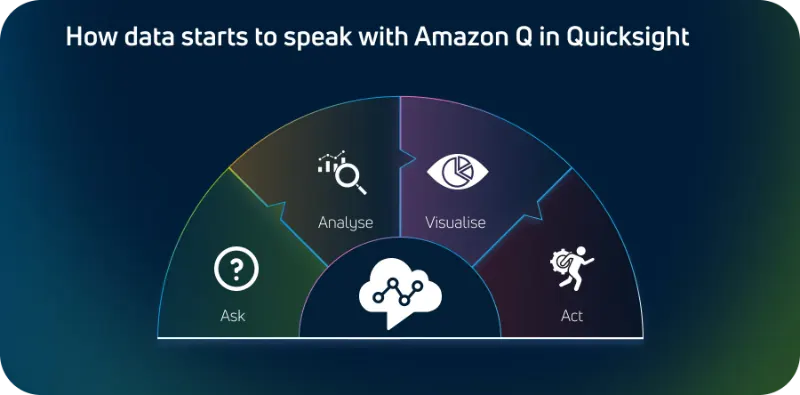
Amazon Q in QuickSight introduces a different way of working with data. Teams can simply ask, 'What were our top-performing regions last quarter?' and see the answer appear instantly. There is no need for complex queries or dependence on technical teams.
Beyond simplicity, it introduces intelligence. Predictive modelling highlights patterns and forecasts outcomes, helping anticipate change rather than react to it. Large datasets and documents are automatically summarised, giving users the information that matters most in moments instead of hours.
With Amazon Q in QuickSight, data moves closer to decision-making. It becomes part of daily conversations, guiding actions across every level of the organisation.
#Market trends driving adoption
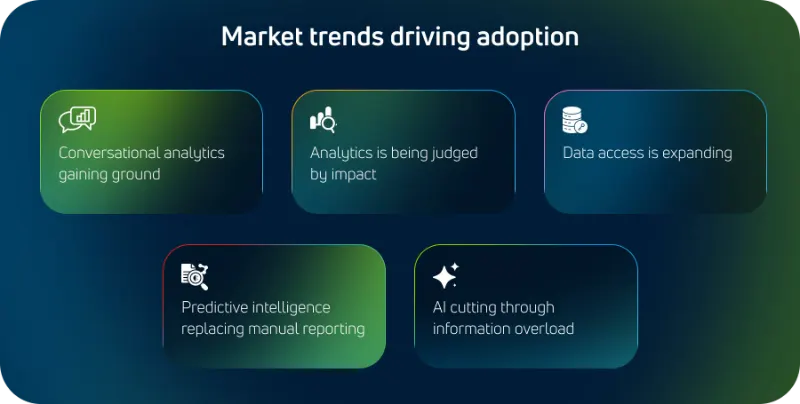
The growing adoption of Amazon Q in QuickSight reflects a wider change in how businesses use data. Across industries, five trends are defining this new era of analytics.
- Conversational analytics is gaining ground Business users expect to interact with data the same way they use everyday digital tools, by asking questions and getting immediate, clear answers.
You can read more about this shift in our article on Generative Business Intelligence with Amazon Q in QuickSight
- Analytics is being judged by impact, not output Organisations now value how insights drive outcomes, not how many reports or dashboards they produce.
- Data access is expanding across roles Teams that once relied on analysts are now exploring data independently, thanks to AI-driven tools that simplify complex queries.
- Predictive intelligence is replacing manual reporting Machine learning models are helping businesses anticipate trends and risks instead of only describing what has already happened.
- AI is cutting through information overload Automated summarisation and synthesis are reducing the time spent navigating large volumes of information, allowing teams to act on what truly matters.
Together, these shifts are changing how organisations approach analytics. The focus is moving from tools to conversations, where data becomes an active partner in decision-making. The future of business intelligence focuses on making data easier to understand, faster to access and more meaningful for the people who use it every day.
#The human side of smarter insights
The real impact of smarter insights shows up in everyday moments where people make decisions.
- A sales manager identifies which products are declining in their region and adjusts the team's focus immediately instead of waiting for an end-of-month report.
- A patient advisor reviews a summary of medical documentation created through AI-powered analysis. With the key points already clear, they spend time discussing care options with patients rather than reading through files.
- A finance leader receives an automated view of spending anomalies. The system highlights patterns that could signal future risks, giving them a chance to act before they become losses.
These moments are where technology meets human judgment, where insight becomes action. People are spending less time searching for information and more time applying it.
Smarter insights give every employee, from advisor to executive, the ability to make confident decisions in the moments that matter most.
#Case study: Data-driven transformation for healthcare analytics platform
#When information becomes hard to reach
A healthcare analytics platform needed faster access to insights without depending on data specialists. Retrieving information required complex queries and manual support, which slowed decision-making and limited agility.
Risk assessment for patient profiles relied on a rule-based model with more than 380 business rules. This approach was difficult to maintain and could not easily adapt to new patterns in patient data.
At the same time, Patient Health Advisors (PHAs) were reviewing more than 120 PDF documents before each consultation, reducing both efficiency and time spent engaging with patients.
#Designing a smarter way forward
Armakuni implemented a solution built on Amazon Q in QuickSight to help the platform move from manual processes to real-time insight.
- Amazon Q in QuickSight allowed the team to ask questions in natural language and receive visual insights instantly, removing the need for technical expertise.
- Amazon Bedrock enabled document summarisation, surfacing key information from hundreds of medical files so PHAs could access relevant insights within seconds.
- A predictive model enhanced the existing rule-based system, using historical data to deliver more accurate and adaptive risk predictions.
The impact was immediate. Decision-making became 98 per cent faster, risk predictions were three times more accurate, and PHAs were able to serve 50 per cent more patients.
#Shaping the future of intelligent decision-making with Armakuni
Business intelligence is entering a new era where insights are embedded in everyday work. With Amazon Q in QuickSight, data becomes part of every decision, guiding teams to act faster and with greater confidence.
Decision-making is becoming more collaborative, grounded in evidence, and shared across the organisation. This shift is both technological and cultural, creating workplaces where clarity drives progress.
The next competitive edge will come from companies that treat data as an active conversation, one that shapes choices rather than simply recording them.
Armakuni ensures that solutions like Amazon Q in QuickSight integrate smoothly into existing workflows, delivering real value without complexity. We bring together technical precision and practical understanding so that data works as naturally as the questions it answers.
When data flows clearly, decisions follow naturally; that's how Armakuni turns intelligence into impact.
Want to see how Amazon Q in QuickSight could fit into your data ecosystem? Let's explore together