If you've ever worked on a delivery where deadlines felt impossible, stakeholder demands didn't quite make sense, or your team was stretched to its limits, you've probably experienced what we've come to call the Triangle of Tension.
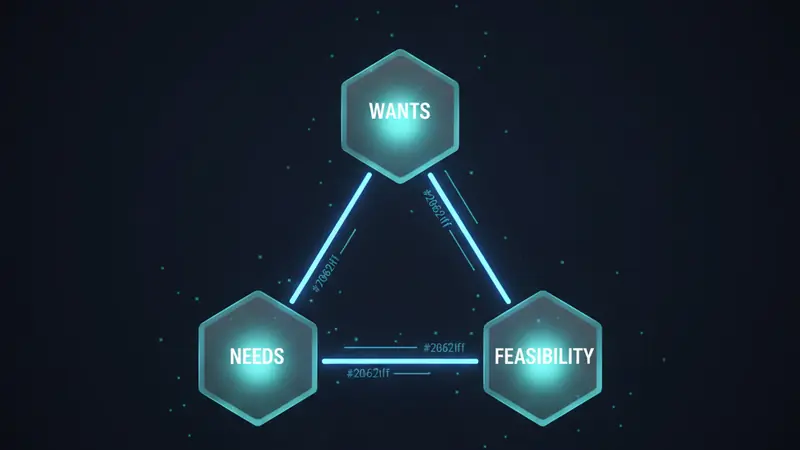
At Armakuni, we see this pattern across organisations: the competing pull of three forces; Wants, Needs, and Feasibility.
- Wants: Often driven by stakeholders or leadership, these can be subjective; desires or even misunderstandings of a need. They're important, but don't always connect back to a clear why or a shared purpose.
- Needs: Grounded in data, research, and insight. These emerge from users, sometimes from teams. Needs represent the real problems to be solved and the outcomes that matter.
- Feasibility: The constraints; whether technical, organisational, or resource-based. These aren't just limitations, as handled well they can spark creativity and force better trade-offs.
When these three forces aren't consciously balanced, teams feel it. During the webinar, we asked people how it feels to be caught in the middle, answers came back fast: frustrated, divided, stressed, angry, threatened. Familiar?
#Stories from the front line
We explored this familiar struggle through two real-world case studies. We heard directly from two leaders in Product Tech Delivery who shared candidly about times when the Triangle of Tension came to life in their organisations.
Misaligned Scale-up Story: At a fast growing scale-up in the accounting space, a Senior Delivery Manager faced unrealistic leadership-imposed deadlines for a critical AI-driven feature. Engineers faced with the reality of building it did not have faith that it would be feasible in the timeframe. The team was under pressure, and alarm bells were ringing. Later, it became clear the timeline was driven by an upcoming funding round, and that the leadership had made a common oversight - they hadn't shared that context with the delivery teams.
After weeks of tension and division, the Senior Delivery Manager organised a pre-mortem during a company retreat. Framed as a "zombie apocalypse" exercise, it asked stakeholders and engineers to imagine the project had already failed and explore why. This surfaced risks and dependencies and gave everyone space to be heard, listen, and align. The outcome: a revised, achievable scope and timeline that balanced leadership's goals with engineering's reality. The takeaway: You don't have to be psychic to surface tension. With the help of structured foresight tools like pre-mortems, you can evolve tension into collaboration without confrontation, or contortions of time-space!
Career Support Start-up Story: At a career-coaching start-up, a "maverick" engineer (described as a blessing and a curse) prototyped an AI tool that the CEO quickly sold to Amazon before the rest of the company even knew it existed. The prototype was unsecure, untested, and misaligned with learning objectives, but sales commitments had already been made. Engineering was frustrated, and the Product Director's role was to help turn the prototype into something sustainable.
The team agreed to rework the roadmap, sacrificing some planned work so engineers could rebuild properly. Weekly sprints, open retrospectives, and introducing tools for non-technical colleagues to experiment with prompts helped distribute the work and reduce bottlenecks. This crisis forced stronger collaboration between engineers, product, and curriculum designers, breaking down silos and ultimately improving the product. The takeaway: Sometimes pressure between Wants and Feasibility can spark lasting improvements in how teams collaborate.
Turning tension into progress
Both these stories illustrate that the Triangle of Tension isn't always negative. Handled consciously, it can:
- Expose gaps in alignment between leadership, product, and engineering
- Force clarity on the why behind decisions
- Prompt better collaboration across disciplines
- Lead to more sustainable solutions that actually meet user needs
At Armakuni, we help teams and leaders work through this tension, not to make it disappear, but to harness it. When Wants, Needs, and Feasibility align, the work doesn't just get delivered, it gets delivered quickly, reliably and sustainably, with the right impact.
Want to try it yourself?
We've created a Triangle of Tension Health Check tool you can use with your team to score your current project: how clear are the Wants? How well understood are the Needs? How confident are you in Feasibility? Try it as a thought experiment, it might surface conversations you didn't know you needed to have.
👉 https://www.armakuni.com/triangle-of-tension
You can also see this practical guide to running a pre-mortem session, one of the techniques that proved so valuable in the first case study story: https://www.atlassian.com/team-playbook/plays/pre-mortem
3 things you can try tomorrow
- Run a mini pre-mortem: Spend 60 minutes as a team imagining your project has failed, then list why. You'll surface risks and hidden assumptions fast. It will be an hour well spent.
- Map your own Triangle of Tension: Ask, how confident are we in what stakeholders want, what users or teams need, and what's actually feasible? Putting this on paper can reveal misalignments. Our online tool can help you do this, and will give you a handy visual to help explain the concept to others.
- Test it yourself: As Faye reminded us, sometimes the best way to cut through debate is to use the product yourself. If it doesn't work for you, it probably won't work for your users.
The Triangle of Tension is inevitable. But with the right mindset, tools, and conversations, it can be a catalyst for better outcomes, and healthier teams. If you're navigating this tension right now and need help unpicking it, that's exactly what we do at Armakuni. Let's talk.