As businesses adopt advanced cloud solutions to manage data and improve operations, generative AI is a growing trend. However, Gen AI isn't always the perfect solution it may seem. The effectiveness of generative AI can be significantly enhanced through Retrieval-Augmented Generation (RAG) architectures deployed on AWS.
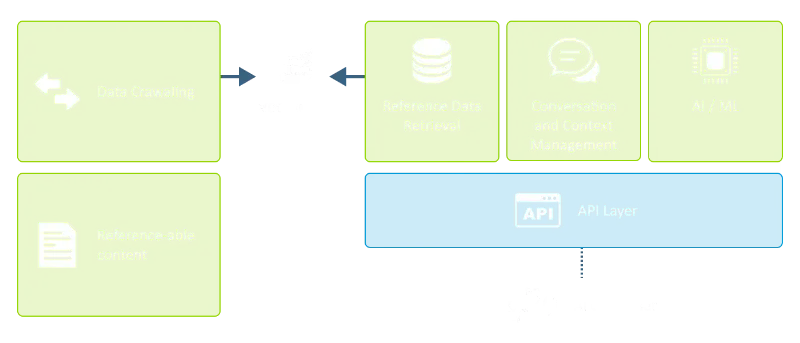
These architectures improve the quality and precision of AI outputs and address challenges in implementing complex systems. This blog breaks down RAG implementations on AWS into five key stages: data crawling, vector database setup, reference data retrieval, conversation and context management, and AI integration. Each stage is important for using Gen AI effectively within your business.
#1. Data crawling
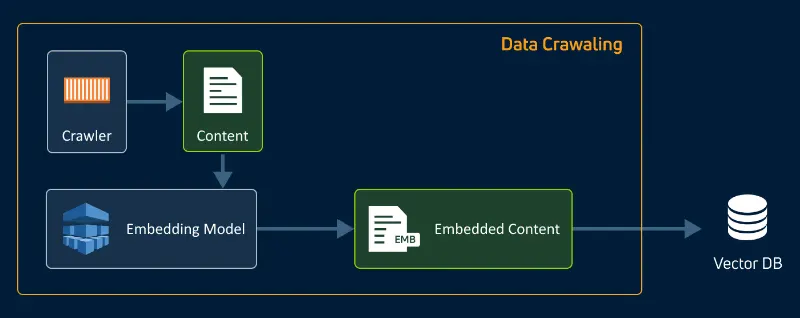
Data crawling is the foundational stage of implementing RAG architectures on AWS. It involves utilizing existing knowledge sources like websites, PDFs, and databases.
Software components systematically scan and extract relevant information from these sources. Extracted data is then cleaned to remove inaccuracies and redundancies, ensuring only high-quality data is processed further.
Next, the data is optimised for storage and retrieval. This often involves using generative AI embedding models. These models transform raw data into a structured format that improves data retrieval and usability in downstream applications.
This step ensures the data architecture is robust and primed for advanced analytics and AI integrations.
2. Vector database
The vector database is a critical component of RAG architectures. It supports the identification of relevant information based on incoming requests and ongoing conversations.
Information is stored in an embedded format, which enables precise and efficient querying while reducing errors. During data ingestion, the vector database consumes embedded data from crawlers. During real-time operations, it performs data querying tasks.
It also effectively indexes the data and maintains high performance under load during data retrieval. Monitoring and scaling the vector database are crucial. Adjustments may be needed to handle increased loads or expand capacity, ensuring robust and responsive operations.
3. Reference data retrieval
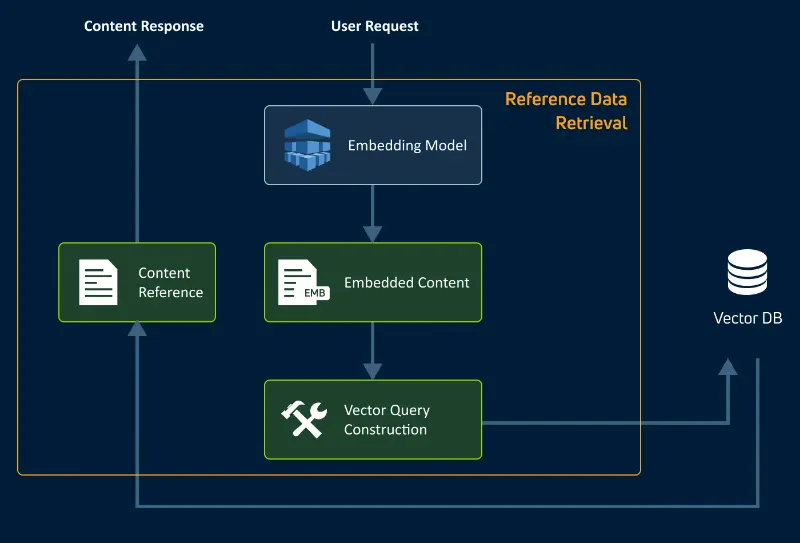
In this stage, incoming requests are transformed into embeddings for querying the vector database.
Text or data from user requests is converted into a vectorised format using embedding models. These models encode semantic meanings and contextual relationships, enabling precise and relevant queries.
The vector database is then searched to identify the most pertinent information. Retrieved data is assembled and formatted for consumption by AI/ML models.
Proper preparation ensures the data fed into AI/ML models is accurate and structured to maximise its effectiveness. This allows the models to generate insights, make predictions, or support decisions with precision.
4. Conversation and context management
Conversation and context management is essential for applications involving natural language processing. Context is important for accurately interpreting and responding to user requests.
This stage tracks and analyses conversational history to provide coherent and contextually appropriate responses. It also personalises interactions by tailoring the generic AI/ML model to individual user specifics through techniques like prompt engineering.
For example, a smaller model can be trained on a user's or company's specific patterns of requests and feedback. This approach enables rewriting requests adaptively before sending them to the generic AI model, facilitating a more tailored interface.
Depending on the product's needs, context data can be stored long-term for ongoing conversations or reset after each session for transient interactions. Efficient management of these requirements ensures continuity and relevance in user interactions.
5. AI integration
AI integration brings intelligence into RAG implementations on AWS. While AWS provides several AI and machine learning services, utilizing endpoints like Amazon Bedrock can be particularly effective for deploying machine learning models at scale.
This stage involves critically evaluating multiple ML models to select one that aligns with specific product requirements. Models are trained using accumulated data and continuously assessed for performance.
This iterative process ensures models enhance capabilities such as predictive analytics, personalised recommendations, and automated decision-making. Refining models over time ensures they remain effective and efficient in real-world applications.
#How Armakuni and AWS simplify RAG system implementation
RAG architectures, when deployed on AWS, simplify the adoption of advanced generative AI technologies. From data crawling to AI integration, each stage builds on the previous one to create a robust and effective system.
These architectures refine AI outputs, enhance decision-making, and boost operational efficiency. By methodically implementing each stage, businesses can overcome the challenges of complex AI systems and capitalise on the opportunities they offer.
At Armakuni, we specialise in guiding businesses through these steps. We help build systems that are efficient, scalable, and aligned with your goals, enabling you to realise the full potential of Gen AI technologies.