Every day, critical business decisions are made without timely data. Take a marketing director at a global SaaS platform who waits ten days for a custom report: by then, competitors have changed pricing, key accounts have churned, and the campaign budget is spent.
This isn't an isolated incident. Organisations invest significant capital in sophisticated data platforms, analytics experts, and enterprise tools, yet 87% of insights fail to deliver business outcomes. We see this pattern consistently in our client work. As an AWS Premier Partner with Data & Analytics Competency, Armakuni tackles this exact challenge through Generative Business Intelligence (GenBI).
Instead of waiting for reports, teams can now ask questions in plain English and get answers in seconds. GenBI replaces static dashboards with two-way conversations with data, providing faster, smarter decisions. This blog will explore how conversational analytics is reshaping data-driven decision-making and delivering tangible results.
#Generative BI transforms how we talk to data
Generative BI applies LLMs to BI systems. Unlike predictive analytics, which forecasts the future, Generative BI helps users understand current and historical data through plain-language queries.
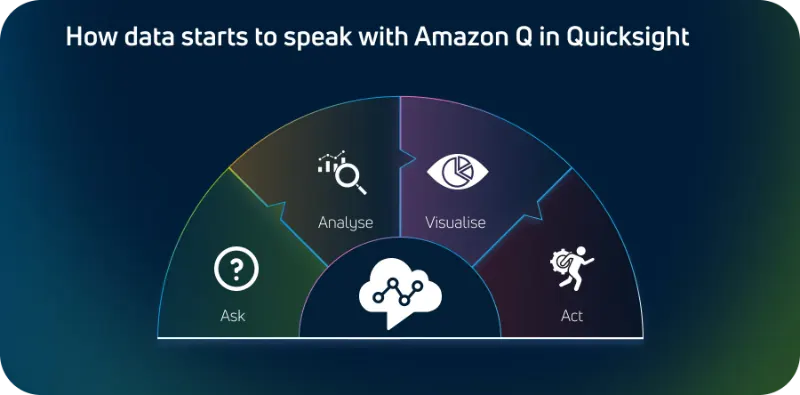
Ask anything anytime with natural language querying
With Amazon Q in QuickSight, a manager can ask:
- "What were our top five products by revenue in the Northeast last quarter?"
- "Why did customer churn increase in March?"
Q responds instantly with a relevant chart or graph.
Armakuni's data engineering teams ensure the semantic layer is configured so Q interprets terms like 'churn' or 'revenue' accurately for your business context.
Non-technical users get answers in seconds without writing SQL or waiting on BI teams, which increases adoption and trust.
Generative authoring: dashboards in minutes, not hours
For analysts, Q is a productivity shift. Instead of hours of manual dashboard building, they can instruct Q:
- "Create a line chart of monthly sales with a forecast."
- "Calculate customer lifetime value by region."
Q instantly generates dashboards, allowing users to perform complex data analysis up to 10x faster than with traditional spreadsheets. This frees analysts to focus on strategy and modelling rather than repetitive report creation.
#Generative BI in practice: a real client story
A global SaaS platform with 12,000 users faced a familiar problem: their analytics worked, but decisions were constantly waiting on data.
Reporting cycles were slow, daily refreshes lagged behind business reality, and non-technical users relied entirely on BI teams. In a multi-tenant environment, even a small misconfiguration risked data leakage and trust.
The solution: self-service analytics with enterprise-grade security
Armakuni implemented Amazon Q in QuickSight to make analytics conversational. Business users could ask questions in plain English and get immediate answers without waiting for BI support.
We built token-based Row-Level Security to guarantee strict data separation across partners, clients, and admin users. With interactive dashboards, anyone could explore data, regardless of technical skill.
The solution combined Amazon QuickSight, Amazon Q in QuickSight, and Amazon Redshift to deliver secure, conversational analytics that scaled across thousands of users.
What changed: speed, independence, and trust
70% shorter turnaround for executive reports, Strategic decisions happened when opportunities were still open
50% lower BI team support effort, The support ticket backlog disappeared.
40% faster partner and client decisions, Partners and clients accessed performance data the moment they needed
100% accuracy in tenant-level data separation, Customer trust stayed intact, compliance concerns disappeared
The semantic layer we built ensured that Amazon Q understood the platform's business terms from day one, so users got accurate answers immediately.
#Three ways Amazon Q makes analytics feel effortless
1) Executive summaries+anomaly detection provide clear context
Amazon Q automates data analysis into executive narrative summaries on trends and key drivers.
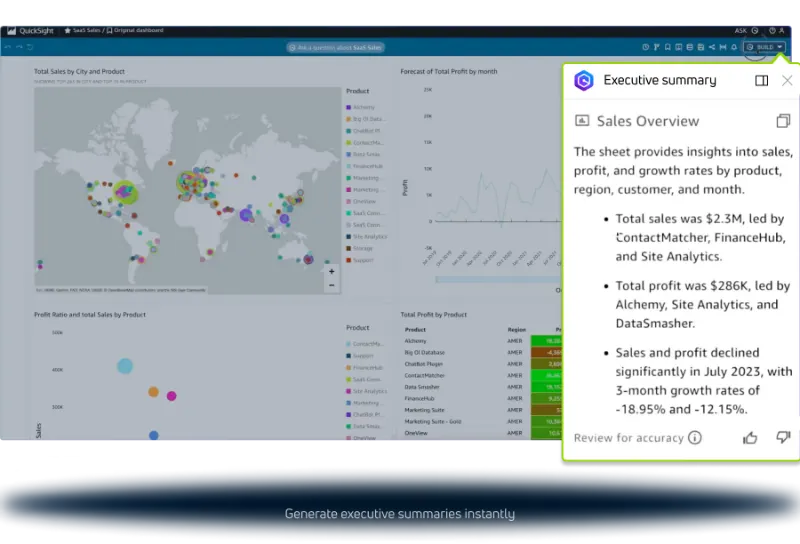
The system also surfaces anomalies and significant trends automatically. In our client deployments, marketing teams detect campaign performance drops within hours instead of weeks. Finance teams catch unusual spending patterns early. Operations teams spot delivery delays before customers notice.
This immediacy moves decisions from weekly refresh cycles to near real-time, helping teams act while information is still relevant and opportunities remain open.
Most importantly, such a context-aware approach explains what happened, why it happened, and what changed.
2) Data storytelling turns numbers into shared understanding
Raw metrics rarely create action. "Q3 revenue was £4.2M" is a fact. "Q3 revenue exceeded forecast by 18% due to enterprise contract wins in healthcare and manufacturing, positioning us ahead of annual targets despite supply chain challenges" tells teams what's working and where to focus.
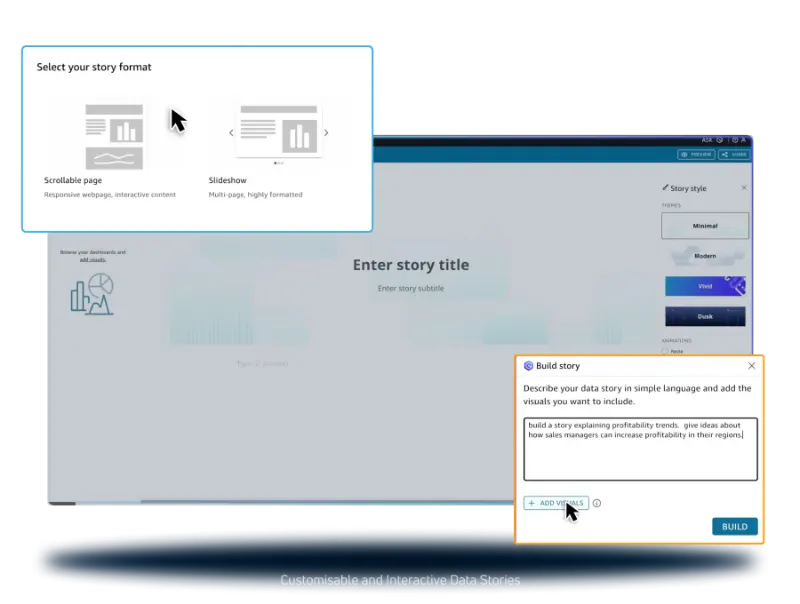
Amazon Q transforms data into narratives that cross-functional teams can understand. Finance, operations, and sales leaders review the same insights and coordinate responses.
With easy-to-understand insights, analytics becomes useful to everyone, not just specialists. In one client project, weekly active users grew from 15% to over 60% within three months.
3) A unified data layer gives the full picture
Amazon Q integrates structured data from QuickSight metrics with unstructured data from documents, emails, webpages, images, reports, and 40+ sources. When a user asks "Why did Q3 sales drop?", the system references both number-based charts and written context from sales reports, market analysis, or customer feedback.
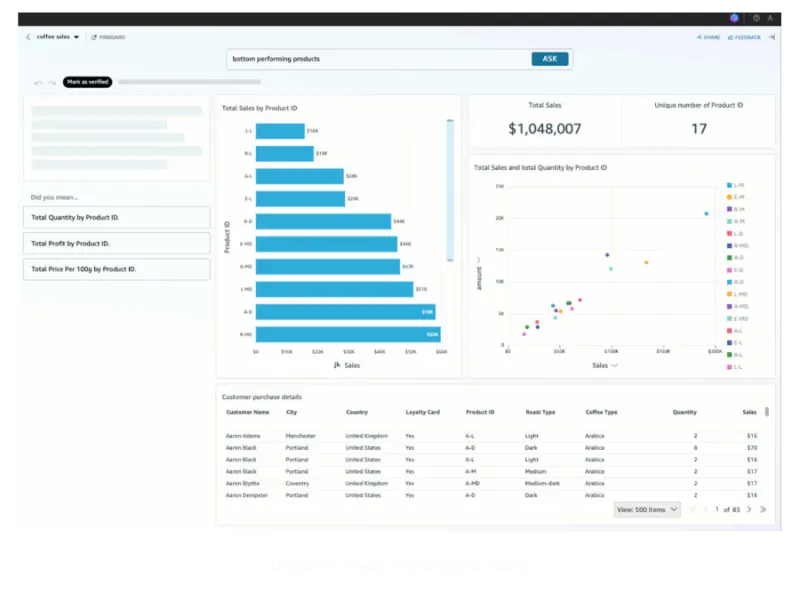
This capability relies on AWS services working together: Amazon S3 for document storage, AWS Glue for data cataloguing, Amazon Redshift for structured analytics, and Amazon Q as the interface. We deliver these unified systems, breaking down silos that have existed for years.
#Transform your analytics journey with Armakuni
Generative BI with Amazon Q lays the foundation to move from descriptive analytics (what happened) to predictive and prescriptive insights (what will happen and what to do).
Armakuni, a AWS AI Competency holder, delivers secure, conversational analytics solutions across SaaS, finance, and technology enterprises. Our 300+ AWS-certified engineers specialise in Redshift optimisation, serverless architectures, multi-tenant security, and semantic layer design.
We identify high-impact BI use cases, launch quick Amazon Q pilots, and scale success across the organisation. Our PUSH framework guides this journey from PoC to production with tailored AWS funding support.
The real question isn't whether to adopt Generative BI, it's how quickly you can turn it into your competitive advantage.